
 Image 1 of 1
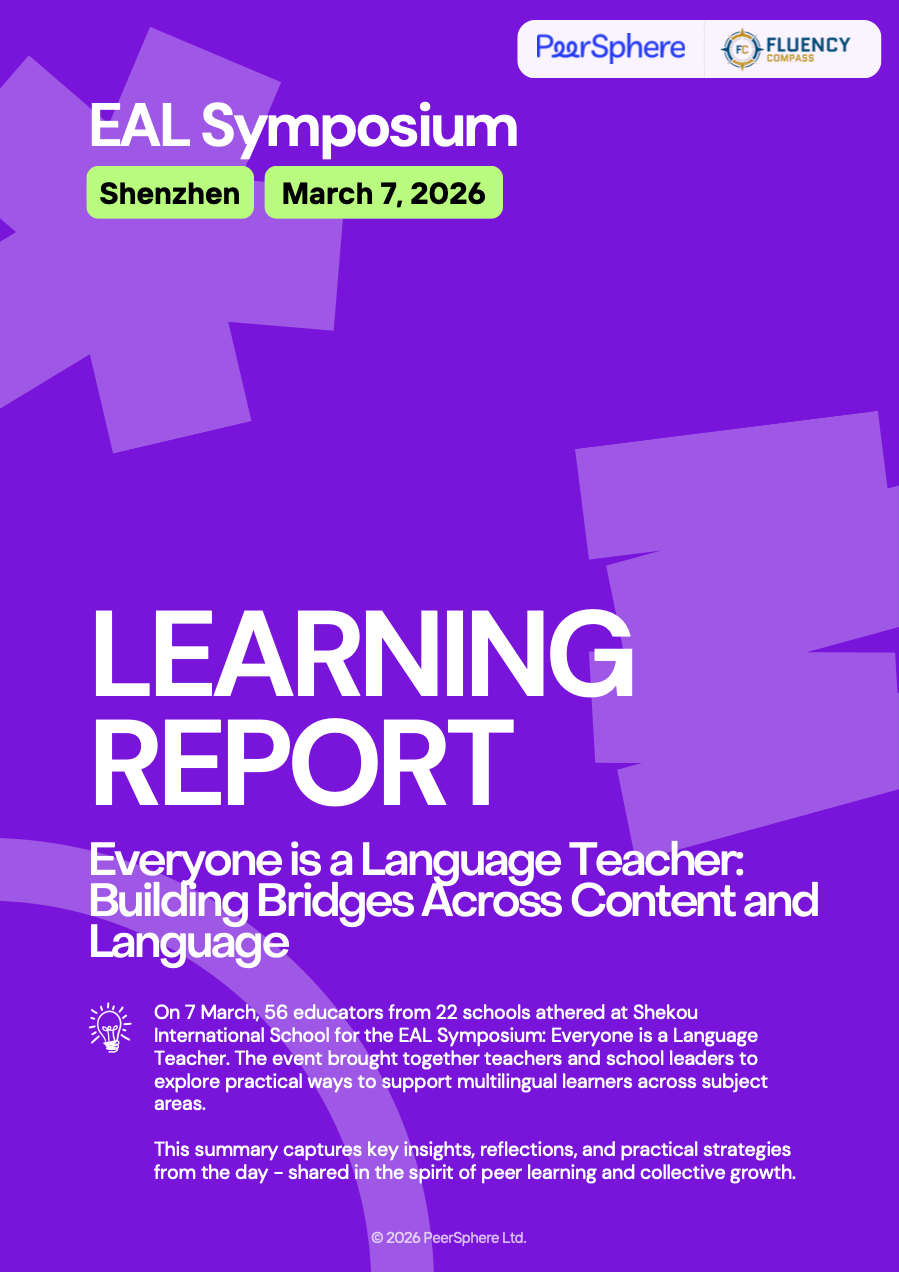
EAL Symposium Learning Report
A comprehensive curriculum and instructional guide for establishing a unified, whole-school approach to language development across all non-language subject disciplines. This resource captures peer-tested strategies from 56 educators across 22 schools to help content-area teachers, EAL specialists, and school leaders intentionally support multilingual learners so language and subject knowledge grow side by side.
Core Focus:
Embedding language learning directly into everyday content-area subject classrooms rather than limiting it to isolated language rooms.
Strengthening academic vocabulary instruction systematically across diverse disciplines including Math, Science, and the Arts.
Mitigating participation inequalities in bilingual or multilingual settings by creating equitable opportunities for deep processing.
Shifting school structures from detached, add-on EAL programs toward shared, cohesive, whole-school language support systems.
Key Insight:
Language learning is embedded in every single subject where students are expected to read, write, discuss, and express their understanding.
Welcoming translanguaging—allowing students to safely navigate between their home languages and English—lowers traditional monolingual bias, boosts classroom participation, and solidifies conceptual understanding.
Verbal "talk" serves as the essential rehearsal stage for literacy; practicing ideas out loud using structured talk frames drastically reduces cognitive load and yields significantly higher-quality written responses.
True vocabulary ownership is rarely accidental; multilingual learners require 15–20 distinct exposures to a word across varied contexts (speaking, reading, and drawing) before they can use it expressively.
Early-years language development is best supported when teachers act as cultural bridges, utilizing low-pressure strategies like "sportscasting" (narrating actions during play) to respect a child’s natural silent period.
Practical Tools:
"Architecting Talk" sentence starters (e.g., "I solved for X by first...") to maintain high academic rigor while facilitating student dialogue.
A 3-step pedagogical translanguaging framework: activating ideas in a student's home language, refining them through a repertoire flow, and synthesizing them into English.
The Fluency Compass system for targeted language assessment, data visualization across four domains, and actionable classroom-ready recommendations.
Daily literacy routines, including sentence unpacking for dense text, word trees, anchor charts, word walls, and disciplinary literacy scaffolds (such as teaching scientific "hedging" language).
Best for:
Homeroom teachers, primary educators, and secondary subject-area instructors (Math, Science, Arts) looking to infuse language instruction into their practice.
EAL specialists, program coordinators, coaches, and bilingual teaching assistants.
School administrators and curriculum directors seeking a roadmap for integrated, collaborative language planning.
March 7, 2026 | Shenzhen, China
EAL Symposium Learning Report
A comprehensive curriculum and instructional guide for establishing a unified, whole-school approach to language development across all non-language subject disciplines. This resource captures peer-tested strategies from 56 educators across 22 schools to help content-area teachers, EAL specialists, and school leaders intentionally support multilingual learners so language and subject knowledge grow side by side.
Core Focus:
Embedding language learning directly into everyday content-area subject classrooms rather than limiting it to isolated language rooms.
Strengthening academic vocabulary instruction systematically across diverse disciplines including Math, Science, and the Arts.
Mitigating participation inequalities in bilingual or multilingual settings by creating equitable opportunities for deep processing.
Shifting school structures from detached, add-on EAL programs toward shared, cohesive, whole-school language support systems.
Key Insight:
Language learning is embedded in every single subject where students are expected to read, write, discuss, and express their understanding.
Welcoming translanguaging—allowing students to safely navigate between their home languages and English—lowers traditional monolingual bias, boosts classroom participation, and solidifies conceptual understanding.
Verbal "talk" serves as the essential rehearsal stage for literacy; practicing ideas out loud using structured talk frames drastically reduces cognitive load and yields significantly higher-quality written responses.
True vocabulary ownership is rarely accidental; multilingual learners require 15–20 distinct exposures to a word across varied contexts (speaking, reading, and drawing) before they can use it expressively.
Early-years language development is best supported when teachers act as cultural bridges, utilizing low-pressure strategies like "sportscasting" (narrating actions during play) to respect a child’s natural silent period.
Practical Tools:
"Architecting Talk" sentence starters (e.g., "I solved for X by first...") to maintain high academic rigor while facilitating student dialogue.
A 3-step pedagogical translanguaging framework: activating ideas in a student's home language, refining them through a repertoire flow, and synthesizing them into English.
The Fluency Compass system for targeted language assessment, data visualization across four domains, and actionable classroom-ready recommendations.
Daily literacy routines, including sentence unpacking for dense text, word trees, anchor charts, word walls, and disciplinary literacy scaffolds (such as teaching scientific "hedging" language).
Best for:
Homeroom teachers, primary educators, and secondary subject-area instructors (Math, Science, Arts) looking to infuse language instruction into their practice.
EAL specialists, program coordinators, coaches, and bilingual teaching assistants.
School administrators and curriculum directors seeking a roadmap for integrated, collaborative language planning.
March 7, 2026 | Shenzhen, China